

Why The Same Mental Health Symptoms And Feelings Keep Coming Back
You can spend years trying to manage or get rid of anxiety, depression, overthinking, emotional numbness, or feeling lost in life, without understanding what’s created the whole experience.


Why The Same Feelings Return:
You can spend years trying to fix what you feel without understanding why you keep feeling it. I think a lot of people live in that situation without realising.
Here’s the thing about trying to fix anxiety, depression, overthinking, lack of motivation, emotional numbness, bad habits, or the strange feeling that life does not feel right anymore.
You might listen to the advice, watch the YouTube videos, begin new gym routines, try journalling, explore meditation, wake up earlier, and keep looking for another way to improve.
Sometimes those things can help because they bring relief, build hope, or give you enough momentum to get through a difficult circumstance.
But my thing is, if you keep trying to fix or manage the symptom without understanding what’s creating it, you can end up going round in circles.
You might change your routine, but the same foggy feeling eventually returns. You might have a positive week, then find yourself back in the same mental place wondering why nothing seems to feel right.
That’s where mental health and self-improvement can become slightly confusing. The advice given around those things isn’t always wrong, but it can make you focus on the first thing you notice, before you understand what’s happening underneath it.
You can spend years fixing something without understanding what’s actually created it. It’s important to start from a foundation, and work upward. You can’t build a house by starting from the roof. Sometimes, no matter how much you dust off a flower just to make it look presentable, if the soil isn’t maintained and the roots aren’t nourished, there won’t be a flower to present.
What Poor Mental Health Symptoms Can Look Like:
We won’t get into the nitty gritty. But for one person, that might be overthinking, emotional numbness, irritability, low energy, avoiding people, losing motivation, comparing themselves to everyone else, feeling behind in life, or feeling like they are working against themselves. It can also show up through subtler symptoms like headaches or tense muscles.
Sometimes, a negative mental health symptom isn’t obvious and can accumulate over time if we aren’t noticing ourselves properly.
It could be waking up and feeling disconnected from your own day. It could be leaving messages unanswered because you feel mentally drained. It could be sitting there knowing what you need to do while feeling like your mind and body are not moving with you.
To some people, these things can come across as laziness, poor discipline, bad habits, or a lack of effort. From the inside, the experience can feel completely different. That’s why phrases like ‘man up’ or ‘we all go through it’ miss the point. People can face similar situations while having completely different abilities to cope with them.
You might know what to do and still struggle to do it. You might want to change and still feel stuck. You might understand the advice perfectly and still feel like something inside you is not responding to it.
I think it helps to ask much more than, “How do I stop this?”
The better question is, “What keeps creating this whole thing?”
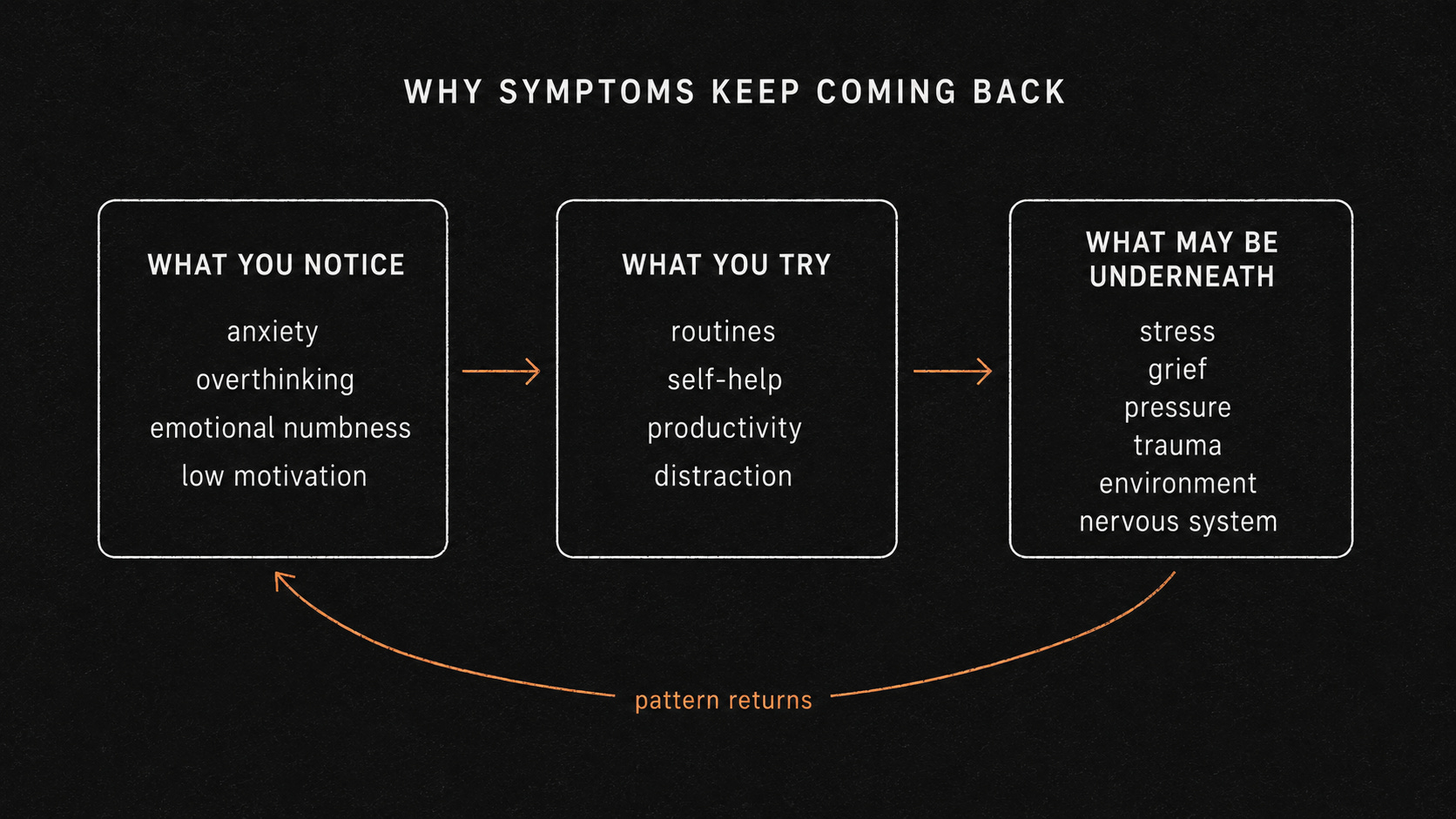
The process can look something like this:
You finally notice what you feel, or how it’s showing up in your body, thoughts, emotions, or behaviour.
Those symptoms may be connected to anxiety, depression, stress, overstimulation, or trauma.
Trying to reduce the symptom can help. Sometimes it gives relief or enough space to function.
If the same thing keeps returning, it may help to look at what keeps steering the wider experience you’re currently living.
Awareness can then help you make changes that are more rational and fit YOU, rather than trying random solutions and hoping one finally works.
This all doesn’t mean every symptom has one hidden or secret agenda. It just means what you’re feeling or how life is may only be one part of the overall picture.
Mental Health Symptoms Can Have More Than One Cause:
‘Mental health’ is rarely as simple as one thing creating one result. Biology, family history, health conditions, medication, life circumstances, trauma, environment, sleep, stress, and smaller factors can definitely overlap.
A phase of depression after grief, pressure, or a major life change isn’t always the same experience as clinical depression. Someone with bipolar disorder can experience depressive episodes as part of that condition. Someone with ADHD might experience depression alongside it, while another person’s level of depression may be more closely connected to their environment, relationships, or what’s been happening in their life.
It’s why understanding and awareness matter. Two people can describe a similar feeling while seeing it through completely different perspectives. The symptom may look similar, but what is driving it can be different.
The Symptom Isn’t Always The Full Problem:
When it comes to mental health, a symptom is often one of the first things you notice, whether it shows up physically, emotionally, or through your behaviour. That doesn’t mean it’s the whole picture.
Anxiety as a whole might be the feeling you notice, but what keeps poking it? It could be uncertainty or fear of the unknown, social pressure, past experiences, your nervous system, environment, your self-image, which then shows up as increased anxiety as a whole thing.
Depression might be the experience you’re trying to run from, but what’s surrounding it? It could be grief, exhaustion, shame, comparison, disappointment, or loneliness.
Overthinking might be overwhelming you, but what’s your mind trying to prevent? Rejection, embarrassment, social discomfort, failure, being misunderstood, making the wrong decision, or losing control?
This is why working only on the visible part can take you so far before the same problem appears again... and that’s with anything in life. Mental health, physical health, relationships, career, finance, business, the list goes on.
It’s sort of like seeing damp on a wall and painting over it. The wall might look better for a year, but the mark will eventually return.
You’ve improved what you can see without finding out where it came from.
Mental health can work like that too. You can improve the appearance of your life, become more productive, disciplined, social, or organised while something underneath doesn’t feel right, seems confusing, or out of sync.
Why Self-Help Advice Doesn’t Work For Everyone:
I think self-help and self-improvement advice can definitely help. Whether it’s a self-help book, a certain morning routine, a positive habit, or a different way of looking at life can find somebody at the right time and give them what they need.
The issue starts when one piece of self-help advice is treated like a universal answer. A one-size-fits-all solution. Which most mental health advice unfortunately is.
Some people need more discipline, some need rest, structure, therapy, practical support, a change of environment, or a clearer understanding of their mind. Some people need to stop avoiding things, while others need to stop forcing themselves through a lifestyle that’s draining them. That’s where a lot of advice misses the person reading or listening to it. Most self-help advice tells people what to do before helping them understand what they are working with.
Wake up earlier, exercise, journal, meditate, get sunlight, stop doom scrolling, eat better, work harder, just think positively, and stay consistent. Most of that can be useful, but what happens when someone tries those things and still feels the same underneath? What happens when somebody is doing the things they are supposed to do while they remain anxious, their nervous system feels overloaded, depression is still present, and life still feels grey?
The self-help advice is presented as something that should work, so when it doesn’t work for a person, they assume they must be the problem. Sometimes the advice is simply not reaching the part of the problem that needs work.
What Happens Under The Surface:
Anxiety and depression can both become things that people try to fight. Mainly because we’re taught that we don’t need anxiety or depression (which we do).
But with anxiety, somebody might focus entirely on stopping the anxious feeling. They might try to calm down, distract themselves, avoid certain situations, force themselves through others, or control everything around them so the anxiety doesn’t fill up.
With depression, somebody might focus entirely on trying to feel better. They might try to become motivated, stay productive, go outside, keep busy, or act as though everything is normal. Again, some of that can help. But if the depressed state is connected to uncertainty, loss of direction, lack of meaning, shame, or years of internal pressure, changes on the outside might not reach all of it.
Things can keep happening or repeating because the deeper issue hasn’t been understood or acknowledged yet.
When you only focus on the obvious, you can miss how your mind is interpreting life, how your nervous system is responding, and how your environment, beliefs, and experiences are painting the overall picture.
Changing Your Life Won’t Always Change How You’re Feeling:
A person can change a lot on the outside and still feel stuck, internally.
They can go to the gym, change how they look, become more social, get a better job, earn more money, improve their daily routine, and still feel like something inside them hasn’t caught up yet.
The problem is assuming every external improvement will automatically change your internal world too.
If someone feels lost, staying busy might distract them without explaining why their life feels disconnected. If someone feels behind in life, reaching one milestone might provide temporary relief while their mind moves the finish line yet again.
The outside is easier to notice, other people can see it, you can post it, and tick it off the list. The internal part is less obvious. It involves looking at what you think, what you feel, what you avoid, how you interpret yourself, and why the same emotional patterns continue returning.
Action still definitely matters... I just think action becomes more useful when you understand what you’re taking action on.
Understanding Yourself Comes Before Self-Improvement:
Before trying to get rid of anxiety completely, which isn’t realistic because anxiety is a normal human response, it can help to understand what your mind is reading as a threat and why.
Before trying to escape depression, it can help to understand what’s made life feel emotionless or pointless. Before trying to stop overthinking, it can help to understand what your mind believes it needs to control. Before deciding that you lack discipline, it might be worth asking whether you’re dealing with avoidance, or trying to force yourself towards something you don’t care about.
All of this doesn’t mean you must understand everything before doing anything. At times you will have to move while still confused. Life doesn’t wait until you’ve found a complete explanation. There’s still a difference between taking action and repeatedly forcing yourself into new routines without understanding why the same things keep pulling you back.
Being aware of something deeply, literally gives action more direction.
Without being self-aware, you can keep trying random fixes and hoping one of them finally changes everything. With it, you can begin noticing what the trigger was, what feeds it, what reduces it, and what keeps taking you back to the same place in life.
What To Think Instead Of “How Do I Fix This?”
When something hurts, it makes sense to want it gone. When anxiety is ruining your day, you want it to stop. When depression is floating like a dark cloud over your life, you want relief. When overthinking is draining you, you just want your mind to become quieter.
However, “How do I fix this?” takes you straight to action before you understand the problem.
A better starting point might be:
Something isn’t right, right?
Where am I and what’s the problem?
What am I thinking and feeling right now?
What keeps triggering this feeling, and why?
What have I already tried that only helped temporarily?
Have I considered everything, or am I choosing based on uncertainty and ego?
Am I behaving rationally or irrationally?
Those questions obviously won’t solve everything on their own, but they can help you stop treating everything as though things appeared from nowhere.
Awareness is the first step before you know what positive change to make.
Summary:
I think people can spend years trying to fix symptoms because symptoms are the part they notice first. Especially if the symptom is physical. It makes sense that somebody would want relief as quickly as possible. Especially in a world that demonises poor mental health.
However, if you never understand what keeps creating a symptom, problem, or recurring negative circumstance, you might continue meeting the same problem in different ways, shapes, and forms throughout life.
That’s why I believe awareness comes way before starting a self-improvement journey. Once you understand more about what you are working with, the next step can become clearer, along with a sense of for yourself, not everyone.
You can spend years fixing problems without understanding what’s creating them. Sometimes that’s why they keep coming back.
Josh DG.
Let me know what part resonated the most. Every like, share, and comment helps this message find the right person who may need it.
Final Thoughts:
Why do mental health symptoms keep coming back?
Symptoms can return when the things you’re trying only reduce what you feel temporarily. If the wider pattern hasn’t been understood, symptoms connected to anxiety or depression, such as physical tension, overthinking, low motivation or emotional numbness, can keep returning in similar or different forms.
Why do I still feel stuck after trying to improve my mental health?
You might still feel stuck because some of the changes are helping your lifestyle without reaching the reason the same internal experience keeps returning. Progress can still be happening, but another part may need understanding.
Why does self-help not work for everyone?
Self-help doesn’t positively affect everyone in the same way because people have different minds, lives, experiences, environments, and levels of mental health. Advice that reaches one person may not reach what another person is dealing with.
Can anxiety improve without understanding what causes it?
Anxiety can sometimes reduce before you fully understand it. But understanding and awareness can help you recognise why certain situations, thoughts, or interpretations repeatedly create the same response, over and over again.
This article about mental health symptoms was written by Josh DG.
Josh DG is a British writer (and creative) whose content focuses on psychology, mental health, and self-improvement. He explores the mind, human behaviour, emotional wellbeing, and why personal growth looks different for everyone.
His work comes from real experiences rather than distant theory. He understands that when it comes to mental health and self-improvement, what works for one person may not work for another.
Connect with Josh DG:
Website: JoshDG.com
Substack: Josh DG
Threads: @_joshDG
X: @_JoshDG
Good piece. The part that stands out to me is that people often try to manage what is visible first, because that is what hurts first. However, the symptom is not always the whole story. Sometimes the real work begins when we stop asking only how to make it disappear and start asking what keeps creating the same inner experience.
Ciao Josh, very interesting article (a bit long 😂). You explore widely the mental health care from the manifestation of a problem, mistakes, assumptions, easy fix not applicable for everyone and the real point. In the end I might say that I found myself a bit in all of it, and at the same time I missed here one thing which is essential. Therapy, in someway you mentioned that "self help" or "self awareness", maybe I just misread, but therapy for me was the real change. What you say about understanding what brings those feeling and memory on the surface, for me was therapy helping me. Anyway a really nice piece, thanks for sharing. Ciao!