

What’s The Difference Between The Brain, The Mind, and Mental Health?
Why understanding this changes how you approach self-improvement.

A lot of people group everything together.
Thoughts, emotions, reactions, behaviour, mental health. It all gets treated like one thing, but it’s not. And when you don’t separate it properly, nothing really makes sense.
You can try to fix your habits, but your thinking doesn’t change. You can try to control your emotions, but they keep coming back. So you end up doing things that sound right, but don’t actually shift anything.
That’s where most people get stuck. Not because they’re doing something wrong, but because they don’t understand what they’re actually working on.
The easiest way to look at it is to break it into three parts:
The Brain
The Mind
Mental Health
They’re connected, but they’re not the same thing.
The brain is the physical part. It’s the thing you can point to, the structure, the chemistry, the part that controls functions, signals, and responses. It processes information at a mechanical level. Everyone has one, and fundamentally, it works in a similar way for everyone.
The mind is different. You can’t see it in the same way, but it’s where everything gets interpreted. It’s where your thoughts gain personality, where meaning gets assigned, and where your perception of things comes from. Two people can go through the same situation and experience it completely differently, not because their brain is different, but because their mind processes it differently. That’s where individuality sits.
Then you’ve got mental health. It’s not a separate system on its own, it’s more like a reflection of what’s going on inside the mind. It’s the overall state of it, how stable your thoughts are, how balanced your emotions feel, and how you’re processing things day to day.
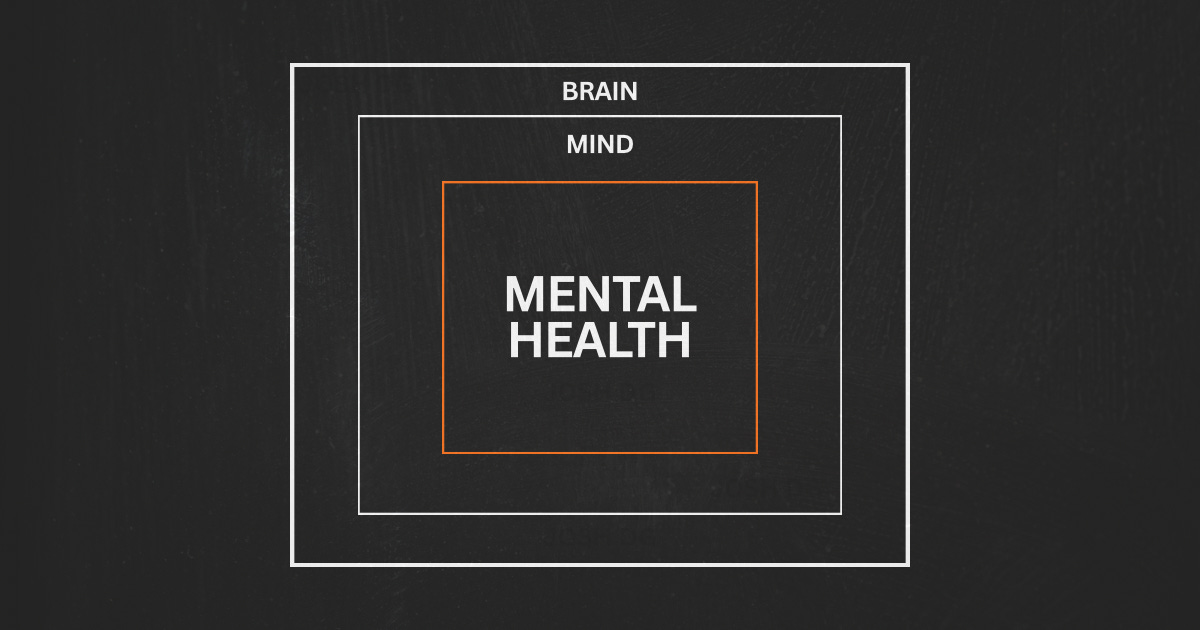
To make it clearer, think of them like this. The brain is the outer box. Inside that sits the mind, and inside that sits mental health. Each layer is connected, but they’re not the same thing.
Another way to look at it is this..
The brain is like your thumb, the mind is your fingerprint, and mental health is how clearly that print shows up. Everyone has a thumb that looks roughly the same, but no two fingerprints are alike. That’s where individuality sits, and that’s why two people can experience the same situation in completely different ways.
I always say your mental health is like a running total or calculation of everything that’s happening daily. So your mental health level adjusts throughout the day. Sometimes more severely than other people.
Your mental health level isn’t fixed. It shifts constantly based on what you experience, what you think about, how you react, and what you take in. That’s why you can feel fine one day and off the next, or unbalanced 20mins after feeling fine. Sometimes triggered by the things happening around you, or sometimes because of genetic or biological reasons.
The problem is, most people try to treat all three things the same. They try to fix thoughts by ignoring them. They try to improve their life by copying routines. But if you don’t understand which part you’re actually dealing with, you end up applying the wrong tool which doesn’t help when managing yourself day to day.
For example, if your mental health is low, adding more structure might help.. but if your thought patterns are the issue, structure alone won’t fix that. If your mind is constantly interpreting things negatively, your mental health will reflect that, even if your habits look good.
That’s why people can have everything in place on the outside and still feel off internally. Because the mind hasn’t shifted.
And that’s also why “just stay consistent” doesn’t work for everyone. Because consistency is behaviour, but not all problems sit at the level of behaviour. Some sit in how you think, some sit in how you interpret things, and some sit in patterns that have built up over time. Those don’t change just because you follow a routine.
Another part people overlook is how these three affect each other. What you experience affects your mind, what your mind focuses on affects your mental health, and your mental health affects how you think, feel, and behave. It’s all connected, but not interchangeable.
That’s why awareness (being aware of yourself and areas of life) matters more than anything. If you don’t understand yourself, you’ll keep trying to fix things at the wrong level.
That’s my understanding of the connection between the brain, the mind, and mental health. There are different perspectives on it, but from my experience, separating them is what actually helps, and something I hope you can take something from.
Josh DG.
Josh DG writes about mental health and self-improvement. He explores the mind, anxiety, and depression, showing why self-improvement only works when mental health is part of the process.
His content is honest and grounded, shaped by experiences rather than distant theory. He understands that when it comes to mental health and self-improvement, what works for one person may not work for another. That belief runs through all of his work, offering perspectives that are real.
Website: JoshDG.com
Substack: Josh DG
Threads: @_joshDG
X: @_JoshDG